
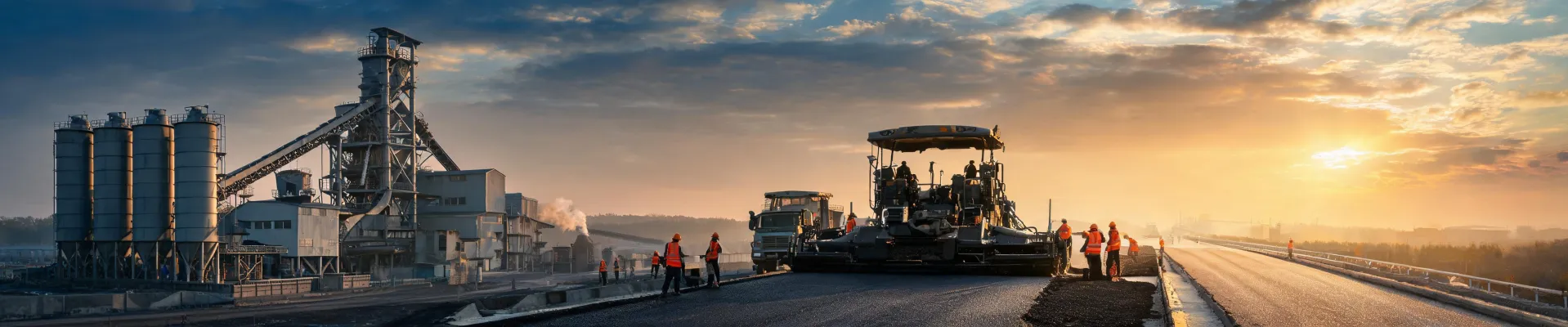
The worst one wasn't an obvious lemon. It was a perfectly good machine that didn't fit the job. In 2019, I sent an RFQ for an Astec asphalt plant. I asked for price, delivery, and payment terms. That felt like sourcing. It wasn't. We got quotes, picked the best number, and six weeks later the real problem showed up on site.
The Surface Problem: Everyone Starts With Price
When buyers search for astec, an astec asphalt plant, a motor grader, a paver, or a compactor, the first question is almost always the same: How much? Then: What's the lead time? Then: Can you do better on price?
Look, I get it. Budget is real. But price is the surface problem. The deeper problem is that construction equipment isn't a commodity. A paver is not a paver. A compactor is not a compactor. A motor grader is not a motor grader. The spec sheet may look similar. The job result won't be.
The Deeper Problem: You're Buying a Fit, Not a Machine
Here's the thing: most bad equipment sourcing decisions happen before the quote. They happen when the buyer doesn't define the job clearly enough to evaluate the quote.
What does Astec Industries do? The short answer is that Astec builds equipment across asphalt, crushing, screening, paving, compaction, concrete, and grading. According to Astec's official product pages, that lineup covers a lot of ground. That breadth is useful, but it also means the wrong Astec product can be just as wrong as the wrong product from anyone else. The brand isn't the fit. The configuration is.
For an astec asphalt plant, the brochure capacity number is not the whole story. You need to ask about aggregate moisture, RAP percentage, fuel type, emission requirements, site layout, and whether the plant can actually hit production on a real Tuesday with real material. I learned that one the hard way.
Motor grader sourcing has the same trap. Buyers compare horsepower and price. But blade width, moldboard type, articulation, weight distribution, and attachment compatibility decide whether the grader finishes a road in three passes or five. On a 12-mile project in 2018, we saved about $4,000 on a grader that was slightly off-spec. Then we spent $6,400 in extra passes, fuel, and operator hours. That math doesn't show up in the quote.
Paver private label is another area where the label matters less than the support. Private-label pavers aren't automatically bad. Some are built by established manufacturers and can be a solid value. The risk is not the nameplate. The risk is unclear parts numbers, inconsistent warranty coverage, and software or service tools that your local dealer can't access. If the paver goes down and you wait nine days for a sensor, the purchase price stops being the main number.
And how to choose compactor for wholesale? This is where I see the most expensive assumptions. A single-drum roller with high amplitude might be great for soil. Put it on asphalt and you can leave marks that require rework. A pneumatic roller might be right for one mix and wrong for another. Wholesale pricing is irrelevant if the machine is matched to the wrong material.
It's tempting to think the brand, the price, or the dealer will solve this. But the complexity is in the application. The machine has to match the material, the climate, the crew, the maintenance capability, and the production target.
The Cost of Getting It Wrong
The cost isn't just the purchase price. It's the gap between what you bought and what the job needed.
In September 2022, we ordered compactors for a paving package without checking drum type against the mix design. The units looked fine on paper. On site, they left surface marks. We had to bring in a different roller, redo two days of work, and explain the delay to the general contractor. That error cost about $3,800 in rework and rental, plus a credibility hit I'm still annoyed about.
I'm not a certified engineer, so I can't speak to structural design or emissions compliance. What I can tell you from a sourcing perspective is that mismatches usually show up in three places: uptime, quality, and resale.
Uptime: if parts take too long, the machine becomes a rental bill. Quality: if the equipment can't hold tolerance, you pay the crew to fix it. Resale: if the spec is odd or the support is weak, the machine is worth less when you trade it. People think expensive vendors deliver better quality. Actually, vendors who deliver quality can charge more. The causation runs the other way.
And the hidden cost is the one nobody budgets for: the team stops trusting the sourcing process. After enough misses, every quote gets second-guessed. That slows down every future decision.
The Fix: A Short Pre-Quote Checklist
The solution is not a longer quote template. It's a better job definition before you ask for a price.
- Write a one-page job spec. Material, production target, site conditions, power or fuel, climate, operator skill, and maintenance capability. No spec, no quote.
- Ask support questions early. Parts lead time, service radius, training, diagnostics, and warranty terms. For a paver private label, verify who built it, where parts come from, and who services it.
- Calculate total cost. Purchase, fuel, maintenance, downtime, and resale. The cheapest quote is often the most expensive machine.
- Match the machine to the material. For motor grader sourcing, check blade width, articulation, and attachments. For how to choose compactor for wholesale, check drum type, amplitude, frequency, and whether it's for soil, asphalt, or both.
- Verify real capacity. For an astec asphalt plant, ask for production at your moisture and RAP levels, not just the brochure number.
- Get it in writing. Specs, exceptions, delivery, commissioning, and training. Verbal promises don't survive a project schedule.
This was accurate as of Q1 2025. Equipment specs, availability, and dealer support change, so verify current details with the manufacturer or dealer.
I'd rather spend 10 minutes explaining options than deal with mismatched expectations later. An informed buyer asks better questions and makes faster decisions. That's the whole point of customer education. Not to make anyone feel dumb—but to keep a $4,000 savings from turning into a $6,400 problem.